
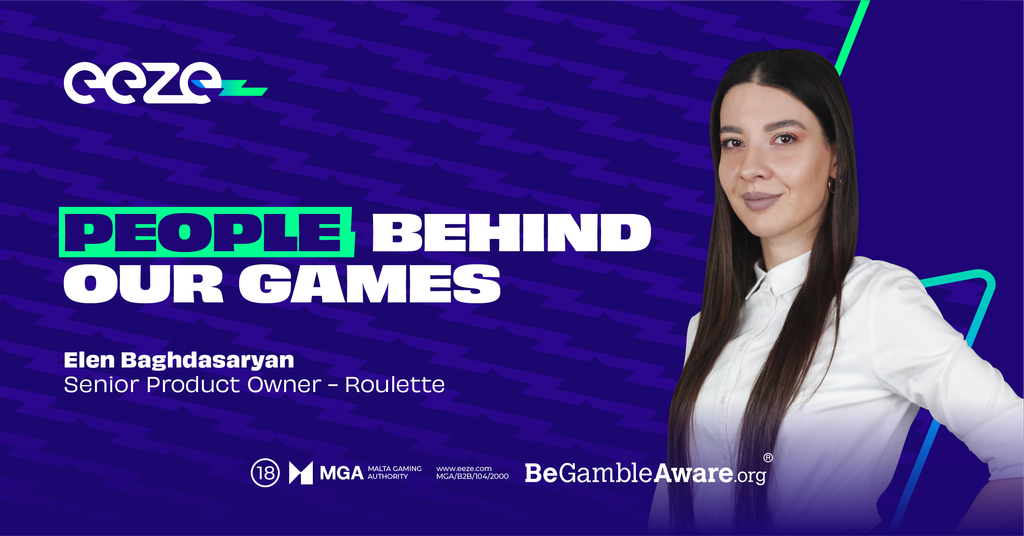
People Behind Our Games: Elen Baghdasaryan – Roulette
Tell me what a day in the life would look like for you – is it the same day-to-day or is it a bet as to what the next day could look like?
Both, honestly.. The frame is stable, the picture inside it changes constantly. Mornings are fairly predictable – numbers, standup, whatever has come in overnight. After that it’s a bet! One day I’m deep in a math model working through payout liability and table limits and the next I’m untangling why a feature behaves differently in one enviroment than another, or reviewing a spin parameter that looked innocent until someone asked the right question. The constant is that roulette gives you a very small surface area and an enormous amount of detail hiding underneath it.
What challenges come with innovating such a traditional casino format, such as a Roulette wheel?
Roulette is about 250 years old and players have muscle memory for it. That’s the challenge and the gift. Anything you add has to survive three tests at once: the math has to hold, the regulator has to be comfortable in every market you’re licensed in, and the player has to recognise the game in the first two seconds. Roulette players are the most conservative revolutionaries you’ll meet. They want something genuinely new that feels exactly like what they’ve always played. Move the wheel one degree in the wrong direction and they will tell you, immediately and in detail!
Eeze’s Fusion Roulette takes the traditional roulette experience and adds AR-driven gameplay, multipliers and a highly customisable visual experience. Where do you see the biggest opportunity to innovate without losing what players already love about roulette?
The core loop is sacred: place your bets, spin, outcome. That’s not where you innovate, that’s what you protect!
The opportunity is in everything wrapped around it. Anticipation, presentation, the reveal, the moment between “no more bets” and the ball settling. That gap is emotionally the richest part of roulette and historically the least designed. AR and multipliers work when they make that moment bigger rather than replacing it. My rule is simple: innovate the theatre, never the engine! If a player has to relearn how to bet, we’ve broken something that took two and a half centuries to get right.
Fusion Roulette gives operators a lot of scope to customise the studio, UI, visuals and branding. How important is that flexibility when you’re designing the product?
It matters enormously, because operators aren’t buying a game, they’re buying something that has to feel like theirs in a lobby with forty other roulette tables in it. Brand consistency, market fit, differentiation. If a product isn’t flexible, it becomes generic, and generic doesn’t survive lobby placement. That said, flexibility needs guardrails. Configurability isn’t a blank canvas. Every option we expose has to still produce a game that’s readable, compliant and playable. Freedom to express your brand – absolutely. Freedom to make the branding on the wheel unreadable – respectfully, no!
How do you decide whether an idea genuinely improves the roulette experience?
I run everything through roughly the same filter. Does the math hold RTP, volatility, payout liability, bet coverage, no unintended exposure? Does it survive integrity review, including the questions nobody asked yet? Is it defensible in every market, not just the friendliest one? And can a player understand it in one sentence, without a tutorial? Then the honest test: does it still perform after the novelty wears off? First-session engagement flatters everything. Retention doesn’t lie and if I need a slide deck to explain a feature to my own team, the player has no chance.
If you were mentoring yourself at the time you started in this industry, what advice would give?
Learn the math sooner, and stop being polite about it. Ask the mathematicians the question you think is too basic, it usually isn’t, and understanding why a limit or a parameter exists is what separates a PO who ships from one who just coordinates.
Second, compliance isn’t the department that says no. Regulatory constraints are design constraints, and design constraints make better products. The teams that treat them as an afterthought pay for it later, always at the worst moment.
And third, the loudest opinion in the room is never the player’s.
What’s one thing people might not expect about you?
I started as a game presenter a decade ago! People are surprised because now I’m the one designing the tables, but what they don’t expect is I still sit down and play them too, just for fun.
Dealer, player, product owner, I’ve seen the table from every seat!
 Português do Brasil
  English (UK)
  Español
  简体中文
简体中文  한국어
한국어  हिन्दी
  日本語
日本語  ไทย
ไทย  Tiếng Việt